Electric Motor
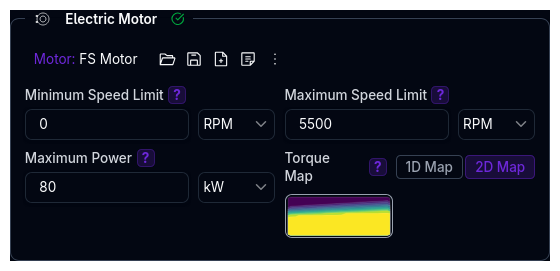
The Electric Motor component defines the propulsion characteristics for electric vehicles. It is only visible when the Power Source Type is set to Electric Vehicle on the Powertrain Overview.
The Electric Motor is an independent library component — it can be saved, loaded, duplicated, and shared separately from the parent Powertrain.
Parameters
Speed Limits
| Parameter | Description | Unit |
|---|---|---|
| Minimum Speed Limit | Lowest RPM the motor can operate at | RPM |
| Maximum Speed Limit | Highest RPM the motor can reach | RPM |
Maximum Power
| Parameter | Description | Unit |
|---|---|---|
| Maximum Power | Peak power output the motor can sustain | kW |
When a maximum power limit is set, the motor will automatically reduce torque at high RPM to stay within the power envelope.
Hub Motor Power
For AWD Hub Motor configurations, this setting applies to each individual motor, not the total combined power. With 4 hub motors, total system power would be 4x the individual motor rating.
Torque Map
The motor's torque characteristics can be defined using two data types:
1D Map (RPM vs Torque)
- X-Axis: Motor speed (RPM)
- Y-Axis: Torque output (Nm)
- Use when: Motor operates at constant voltage, no field weakening, or limited data available
2D Map (Voltage vs RPM vs Torque)
- X-Axis: Applied voltage (V)
- Y-Axis: Motor speed (RPM)
- Z-Axis: Torque output (Nm)
- Use when: Modelling voltage-dependent torque characteristics or field weakening strategies
Choosing Between 1D and 2D
Use 1D maps for simple motor models. Use 2D maps when you have voltage-dependent data — this is important for motors that employ field weakening, where torque changes significantly with voltage at high RPM.
See Data Types for details on map editors.
Regenerative Braking
The motor can provide regenerative braking by applying negative torque during deceleration. The amount of regenerative torque available is the inverse of the propulsion torque at the current RPM.
Regenerative braking power is limited by the battery's Maximum Charge Power setting (configured in the Battery component). If max charge power is set to 0, no regenerative braking occurs.
Validation Warnings
| Condition | Warning |
|---|---|
| Operating range < 3,000 RPM | Narrow operating range may limit performance |
| Torque curve variation < 10% | Unusually flat torque curve — check motor data |
| Maximum power < 10 kW | Low maximum power limit — verify motor specifications |
| 2D map with only one voltage point | Voltage-dependent motor has only one voltage point in its map |
Tips
- Start with a 1D map if you don't have voltage-dependent data — you can always upgrade to 2D later
- Match motor to battery — ensure motor voltage requirements align with battery pack voltage (see Powertrain Overview for EV source warnings)
- Set RPM limits to match your data — the min and max RPM should align with your torque map range
Next Steps
- Configure Battery for energy storage and voltage supply
- Set up Gears for transmission ratios and shift strategy
- Configure Efficiency to model drivetrain losses
- Return to Powertrain Overview