Anti-Roll Bars
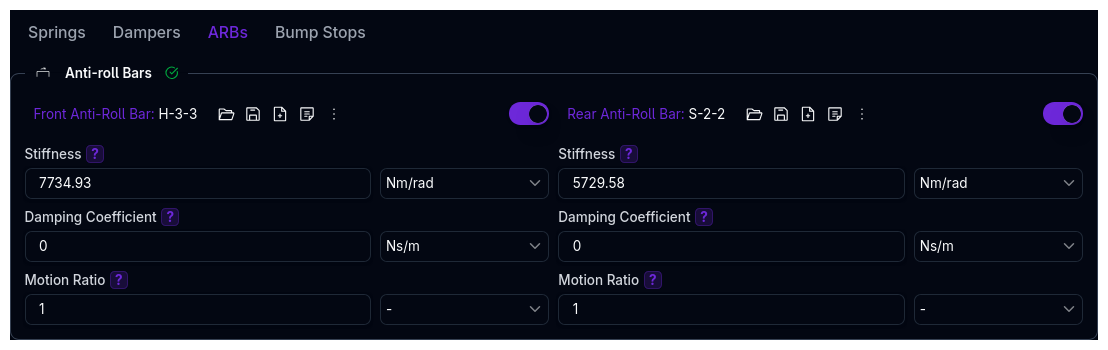
Configure anti-roll bars (ARBs) for front and rear axles. ARBs resist body roll by coupling left and right wheel movements, redistributing lateral load transfer between the front and rear axles.
ARBs are optional — they are toggled on or off independently per axle. When disabled, no roll stiffness contribution is added from the ARB.
Parameters
| Parameter | Description | Unit |
|---|---|---|
| Stiffness | Torsional stiffness of the anti-roll bar | Nm/rad |
| Damping Coefficient | Damping rate of the anti-roll bar | Ns/m |
| Motion Ratio | Installation ratio between ARB twist and vehicle roll (see below) | - |
ARB Motion Ratio
Unlike spring and damper motion ratios (which are calculated from kinematics geometry), the ARB motion ratio is entered directly on this page. This is because the ARB linkage geometry is typically independent of the main spring/damper actuation.
The ARB motion ratio is the ratio between how much the anti-roll bar twists for a given amount of vehicle roll:
Motion Ratio = ARB Twist Angle (rad) / Vehicle Roll Angle (rad)
It is a unitless value. A higher motion ratio means the ARB twists more for a given amount of vehicle roll, making the roll stiffness contribution effectively higher.
The effective ARB rate at the wheel is:
Similarly, the effective ARB damping rate at the wheel is:
Validation Warnings
| Condition | Warning |
|---|---|
| Stiffness is zero | Zero stiffness — ARB has no effect |
| Stiffness > ~500,000 Nm/rad (~8.7 kNm/deg) | Very stiff anti-roll bar |
| Motion ratio < 0.3 | Very low motion ratio |
| Motion ratio > 2.0 | Very high motion ratio |
Related Pages
- Suspension Overview — Component hierarchy and page layout
- Springs — Corner and heave spring configuration
- Kinematics — Motion ratios and geometry