Springs
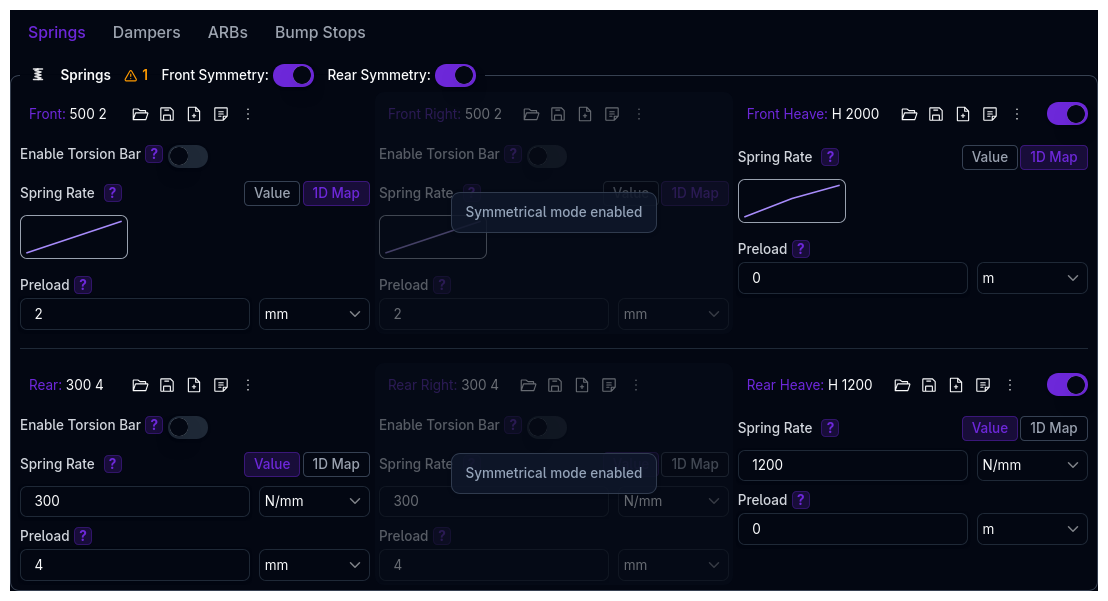
Configure corner springs and optional heave springs for each axle. Springs are the primary load-bearing element of the suspension and determine ride height, ride frequency, and weight transfer characteristics.
Each corner spring is an independent library component that can be saved, loaded, and shared separately.
Spring Types
Two spring types are available for corner springs. The type is determined by the actuation configuration in Kinematics.
Linear Spring
The default spring type. Operates in the linear (translational) domain, producing a force proportional to displacement.
| Parameter | Description | Unit |
|---|---|---|
| Spring Rate | Stiffness of the spring — constant value or 1D map (Distance vs Force) | N/m |
| Preload | Compression already in the spring at full extension (top-out), measured from its free length | m |
The Spring Rate supports two data type modes:
- Value — a single constant spring rate
- 1D Map — a lookup table of displacement (m) vs force (N) for progressive or degressive springs. Displacement is spring compression from the free length, so a positive displacement must give a positive force.
Preload
Preload is the compression the spring is held at when the damper is fully extended (at top-out). It is not the compression at static ride height. The spring is captive and cannot extend past its preloaded length.
- Preload force. At top-out the spring already pushes with
Spring Rate × Preload, or the map's force at the preload distance. The wheel does not leave its stop in droop until the load on the spring exceeds this force. - Static ride height does not change. A spring carrying a given load is always compressed by the same amount, with or without preload. Adding preload does not raise or lower the car at static. It changes how far the corner can droop before it tops out, and so where it unloads.
- Topped out at static. If the preload is larger than the static compression, the spring sits against its top-out stop at rest. That corner then carries no spring load and adds no wheel rate. This raises the Spring topped out at static warning (see below).
Example
A 100 N/mm spring carrying 2,000 N at static is compressed 20 mm. With 5 mm of preload, it still sits at 20 mm compression at static. It can extend 15 mm before it tops out, where it still pushes with 500 N. With 25 mm of preload, the spring is topped out at static.
Torsion Bar
A torsion bar operates in the angular (rotational) domain, producing a torque proportional to rocker angle. Torsion bars are only available when the actuation type is set to push/pull rod with rocker in Kinematics. When actuation is set to direct-acting, the torsion bar option is disabled.
| Parameter | Description | Unit |
|---|---|---|
| Torsion Bar Stiffness | Rotational stiffness — constant value or 1D map (Angle vs Torque) | Nm/rad |
The Torsion Stiffness supports two data type modes:
- Value — a single constant torsional stiffness
- 1D Map — a lookup table of angle (rad) vs torque (Nm)
When to Use Torsion Bars
Torsion bars are common in Formula-style cars with rocker-actuated suspension. If your suspension is direct-acting (e.g., most production cars, GT cars), use linear springs.
Motion Ratios and Effective Rates
Spring parameters are entered at the component level (i.e., the physical spring itself). The motion ratio from Kinematics converts between component-level values and wheel-level values.
Linear Spring Motion Ratio
The spring motion ratio is the ratio between how much the spring moves relative to how far the wheel moves:
Motion Ratio = Spring Travel / Wheel Travel
It is a unitless value, typically less than 1. A higher motion ratio means the spring moves more for a given amount of wheel travel, making the suspension effectively stiffer. The effective wheel rate is:
Torsion Bar Motion Ratio
For torsion bars, the motion ratio is the ratio between the rocker angle and the wheel travel:
Motion Ratio = Rocker Angle (rad) / Wheel Travel (m)
This has units of rad/m. A higher motion ratio means the torsion bar twists more for a given amount of wheel travel, making the suspension effectively stiffer. The effective wheel rate is:
Motion ratios are read-only
Motion ratios are not entered on the Springs page — they are calculated from the suspension geometry defined in Kinematics. The Suspension Metrics panel shows the current motion ratios and resulting wheel rates.
Heave Springs
Heave springs are optional and toggled independently per axle. When enabled, a heave spring acts on the average wheel displacement of the axle, providing additional vertical stiffness without affecting roll stiffness.
Heave springs are always linear springs:
| Parameter | Description | Unit |
|---|---|---|
| Spring Rate | Heave spring stiffness — constant value or 1D map | N/m |
| Preload | Compression already in the heave spring when it first engages | m |
The heave spring has free travel before it engages. That is the Heave Spring Gap in Initialization, measured from static ride height. Until the gap closes, the heave spring produces no force.
Heave spring preload works differently from corner spring preload. There is no top-out. Once the gap closes, the force rises to the preload force (Spring Rate × Preload) over the first 0.3 mm of travel. After that it follows the spring rate. A preloaded heave spring therefore gives a step in heave stiffness at engagement, as if it had been installed already compressed.
Heave Springs
Heave springs allow you to decouple ride stiffness from roll stiffness. A softer corner spring with a heave spring can give the same ride rate but lower roll stiffness than a stiff corner spring alone.
Validation Warnings
| Condition | Result |
|---|---|
| Negative spring rate, or a 1D map whose force has the wrong sign for its displacement | Error: the setup cannot be built |
| Preload < 0 | Warning: negative preload |
| Preload greater than the static compression of the spring | Warning: spring topped out at static ride height. The corner carries no spring load and adds no wheel rate. Reduce the preload or soften the spring. |
| Linear spring motion ratio below 0.3 or above 2.0 | Warning: spring motion ratio very low / very high. Check the kinematics. |
| Axle has no vertical stiffness at static ride height | Critical: the car is not supported on that axle, and its ride frequencies are reported as zero. Usually caused by topped-out springs, a zero spring rate or zero installation stiffness. |
Related Pages
- Suspension Overview — Component hierarchy and page layout
- Dampers — Damping configuration
- Kinematics — Actuation type and motion ratios
- Data Types — Value vs 1D Map modes